broker review
Crypto Escrow Review: A Practical Walkthrough of Setup, Transfers and Support
Choosing a wallet has less to do with the feature list and more to do with how it behaves once you actually use it. This Crypto Escrow review works through the platform the way a new user meets it: creating the wallet, handling assets, moving coins in and out, and judging what it does and does not protect you from.Crypto Escrow is a non-custodial online wallet, which means the keys stay on your device rather than sitting on the company’s servers.
Accounts and Getting Started
Setup is short. You either create a new wallet or open an existing one, and key generation happens on your own device. The wallet then issues a recovery phrase of 12 or 24 words and asks you to write it down and keep it somewhere offline.
Account settings cover the ordinary things, including your name details and password, and the recovery phrase can be displayed again from there if you need it. Onboarding is deliberately light and moves quickly, though beginners still face the learning curve that self-custody always brings.
Assets and Everyday Transfers
The wallet opens on one main screen with your total balance in view, and a toggle to hide it when you happen to be somewhere public. Hold several coins and the “My Assets” search becomes genuinely useful, while a live price board along the top follows movement in Bitcoin, Ethereum and others without sending you to a second app.
Moving funds is uncomplicated. To send, you pick the wallet, paste the recipient address, enter an amount and confirm. To receive, the wallet displays your address next to a QR code you can copy or share. Everything settles directly on-chain with no intermediary layer in between, and the transaction history is organised well enough to trace an old transfer without hunting for it.
Security and Support
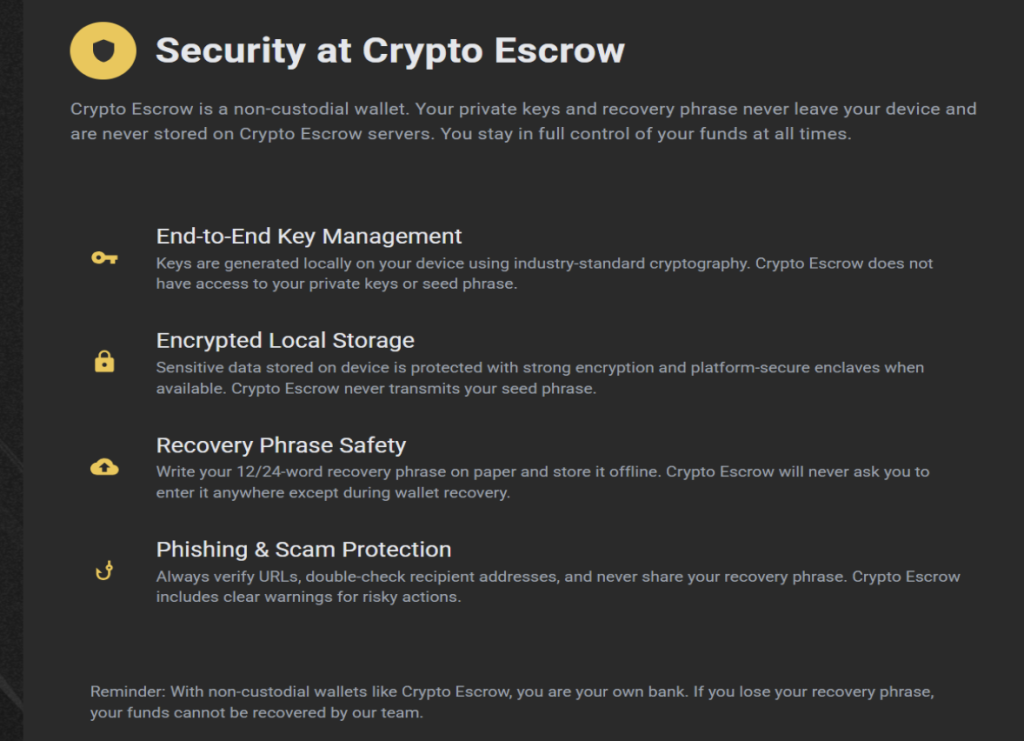
Security is where the non-custodial model does its work. Key generation stays on the device, and neither the keys nor the seed phrase are held by Crypto Escrow at any point. The practical consequence is that your recovery phrase is the only backup in existence, which is why the wallet is so insistent about keeping it offline and away from screenshots.
Its security pages spell out how this works instead of leaving it vague, and the platform is equally blunt that no message from it will ever ask you to reveal that phrase, whatever the pretext.
Support is documentation-led rather than staffed around the clock. Guidance pages and informational sections carry most of the load, which suits confident users and leaves newcomers doing more of their own reading.
Pros and Cons
What this Crypto Escrow review kept returning to is that the strengths and the limits grow from a single design decision. On the positive side, keys stay with the user, the interface stays uncluttered, and the wallet resists becoming an exchange, a marketplace and a trading terminal all at once.
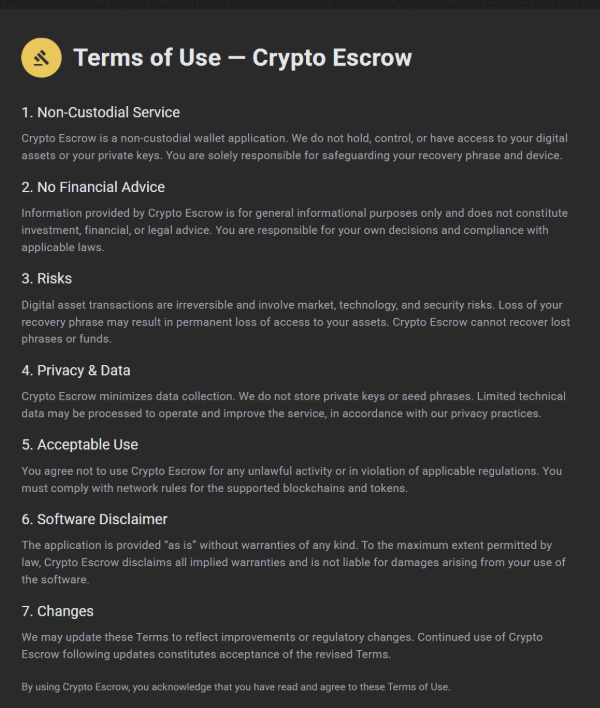
The same narrowness draws the boundaries. Lose the recovery phrase and nobody can restore it for you, so responsibility genuinely sits with the holder. Anyone hoping for deep analytical tooling will find the experience basic. Whether that counts as a weakness depends entirely on what you wanted the wallet to do.
Taken together, this Crypto Escrow review points to a wallet that is easy to grasp and honest about what it asks of the people using it. Readers weighing up options can also read the Crypto Escrow review on ReviewCharts, which adds a further outside view. For anyone comfortable holding their own recovery phrase, Crypto Escrow is a clear and workable option for storage.