broker review
FinTracer Review: How It Actually Classifies Who You Are Dealing With

Most tracing tools will tell you a wallet is risky. Far fewer will tell you why, and that gap is where a lot of the real decision-making happens. This FinTracer review sets that question at the centre, not whether the platform flags a wallet, but what it actually tells you once it has.
A flag is not an answer
Anyone who has used a basic blockchain explorer knows the frustration. A wallet shows some warning icon, a vague red mark, and you are left guessing at what it actually means. Is it a stolen-funds wallet, a sanctioned address, a mixer, or just a service with a bad reputation? Those are four completely different situations, and treating them the same way is close to useless when you are the one deciding what to do next.
FinTracer separates them out. Rather than a single risk badge, it works to classify what a flagged wallet or service actually is, distinguishing between categories such as a mixer designed to break up a trail, an address linked to a known theft, a sanctioned entity, or a high-risk exchange with weak controls. The distinction changes what you do next, and this FinTracer review found that distinction to be the platform’s real strength.

Why the category matters more than the colour
Say a wallet you are checking touched a mixer three hops back. That is a caution, not a verdict. Mixers get used by people protecting ordinary privacy as well as by people hiding something.
Now say the same wallet is a couple of hops from an address tied to a confirmed exploit. That is a different order of concern entirely, one that should change your next move. A flat “high risk” label collapses both cases into one. FinTracer’s entity classification is built specifically to keep them apart.
Where this shows up in practice
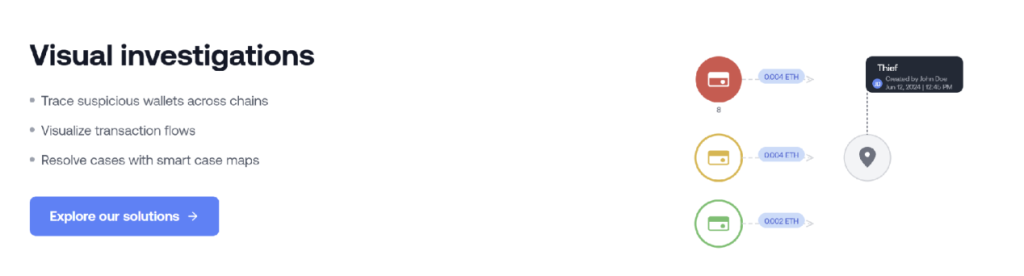
The classification sits underneath the platform’s visual trail mapping, so it is not a separate lookup step. As a route unfolds across wallets and services, each flagged point carries its category along with it, which means you are reading a labelled map rather than a plain one dotted with unexplained warnings.
That matters most exactly when a trail runs long. A route with six or seven hops and two or three flagged points is hard enough to hold in your head without also having to guess what each flag means.
Access and the honest limits
Getting in is simple. FinTracer studies activity rather than holding it, so there are no account tiers to pick through and no balance to fund before your first trace.
The classification detail is a real strength, but it still asks something of the reader. Knowing that an address is tied to a mixer is only useful if you already understand roughly what a mixer does, and FinTracer does not spend much time explaining the categories themselves. A short glossary alongside the flags would close that gap. Other users’ impressions are gathered separately, over on ReviewCharts, under the FinTracer review listing.
The verdict
Plenty of tools can tell you a wallet looks risky. Fewer can tell you what kind of risky it is, and fewer still make that distinction the centrepiece rather than an afterthought. For anyone who actually has to act on a flag rather than just see one, that difference is the whole point. This FinTracer review comes down on the side of a platform that treats classification as the point of the map, not decoration scattered around it.
METADATA
- Title: FinTracer Review: How It Actually Classifies Who You Are Dealing With
- Meta Description: A FinTracer review that looks past the risk flag itself, at how the platform actually classifies what a flagged wallet or service is. (139 characters)
- Slug: fintracer-review-entity-classification