Cryptocurrency
Why Litecoin XRP And Solana May Be Smart ETF Picks For New Investors?
Introduction
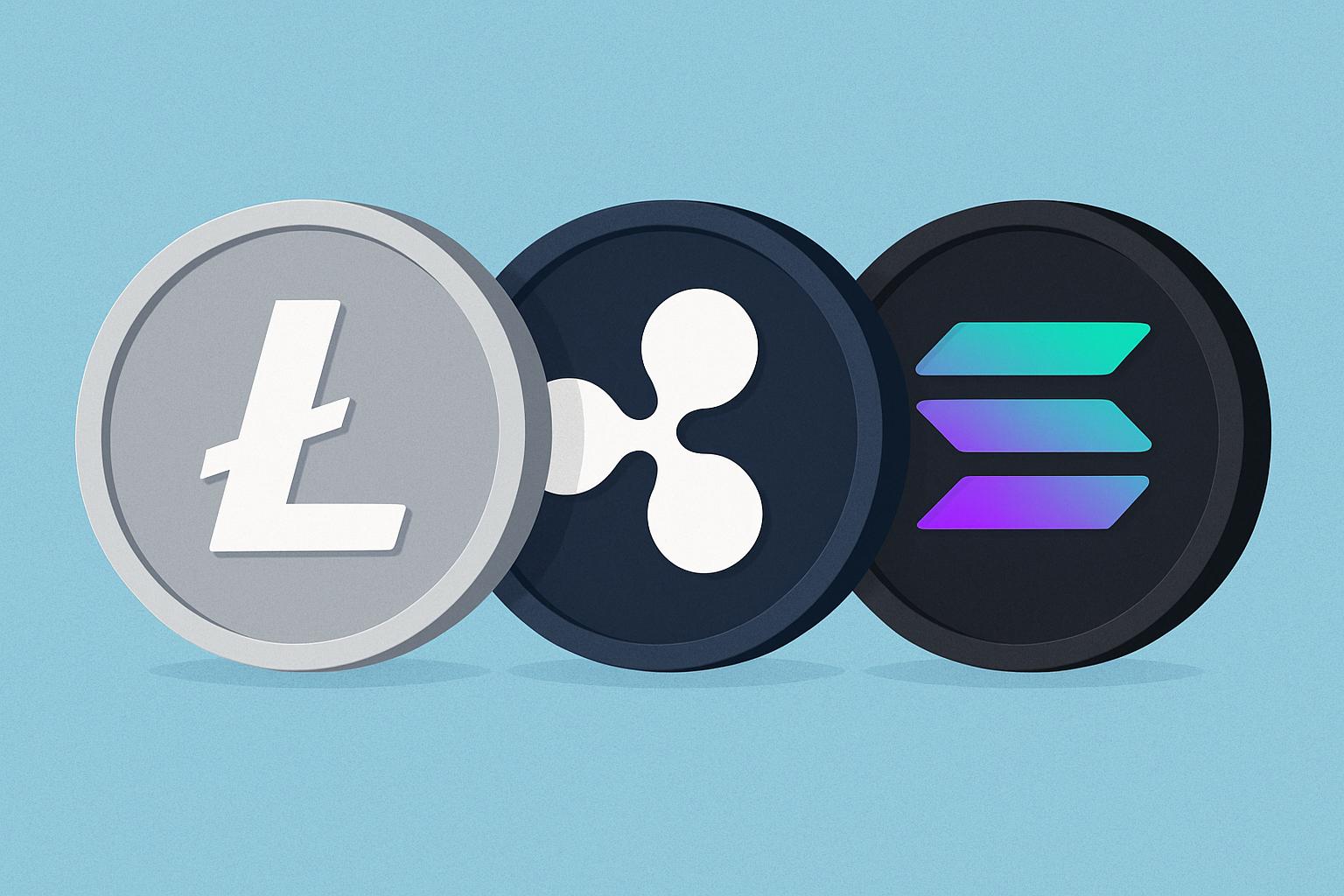
As of late 2025 there is growing optimism in the crypto community that several blue-chip assets are on the cusp of gaining exchange‐traded fund (ETF) status. Among those most frequently mentioned are Litecoin (LTC), XRP, and Solana (SOL). With regulatory clarity improving their institutional readiness increasing and strong market fundamentals behind them these assets are being viewed by many new investors as among the safest ways to participate in the crypto rebound if ETFs are approved.
Institutional Momentum And ETF Approval Odds
One of the central arguments favoring LTC XRP and SOL is that they are perceived to have very high odds of obtaining ETF approval. According to recent estimates these odds are approaching 95% by around October 2025. This is a striking assertion since ETF approval effectively means that institutional investors who previously refrained from holding non-Bitcoin/Ethereum cryptos may now have a regulated vehicle into these alternative assets.
An ETF provides a trusted framework: custody solutions, audited holdings, regulatory oversight, daily disclosures. All of these reduce counterparty and regulatory risk which so many institutional players are wary of. Once that happens for LTC XRP and SOL, many expect large inflows of capital, not only from hedge funds and family offices, but from more conservative institutional investors too.
Regulatory Clarity: A Key Factor
Regulation is one of the biggest obstacles in the crypto-asset world. If an asset is deemed a “security” under U.S. law many funds and investors are restricted or prohibited from holding it. In contrast assets classified as “commodities” or “not securities” avoid many of those limitations.
Litecoin is frequently cited as having strong regulatory clarity. It is widely considered more like a commodity than a security, which reduces legal exposure and simplifies its inclusion in investment products.
XRP has had a long battle with the U.S. Securities and Exchange Commission (SEC). However recent developments are argued to have given XRP better prospects of satisfying regulatory requirements and being treated more favorably under securities law.
Solana is a layer-1 blockchain with growing integrations and usage. It has seen increasing institutional interest, which tends to push regulators to clarify or define frameworks for assets like it.
Because of this regulatory momentum, many analysts view LTC XRP and SOL as being far more ETF-friendly than many smaller altcoins.
Market Performance And Price Potential
Having regulatory backing is one part of the equation; price action, liquidity, developer ecosystem, and market adoption are equally important. Here’s how each of these three is performing and what upside potential looks like under current conditions.
Litecoin (LTC)
Litecoin has shown strong recent performance metrics. It reportedly rallied about 34.8% in the last month according to the source, moving toward a resistance zone around $137. If that resistance is cleared, targets in the $175-$200 range are cited.
Key supportive features for LTC include:
CME futures: These offer more institutional familiarity and avenues for hedging.
Daily liquidity: Large daily volume, in the billions, improves exit and entry options for large investors.
Uptime & reputation: Litecoin has been operating for many years, with strong network stability and fewer major controversies.
Because of those features its behavior is expected to be more stable and less explosive—but for many investors, that slower but more reliable upside is acceptable.
XRP
XRP is positioned as perhaps the most interesting case in terms of regulatory clarity. Having endured legal battles with the SEC, XRP now is being spoken of with ETF possibilities nearly on par with LTC and SOL. Price at the moment of the report is quoted near $2.81, and some analysts believe that inflows post ETF-approval could be in the $5-8 billion range.
Upside potential for XRP under favorable conditions is put somewhere between $8 and $12, assuming institutional money moves in and adoption continues through partnerships (especially in the banking and payments sectors). XRP reportedly has over 300 banking partners and is seen as one of the more “enterprise friendly” crypto assets in play.
Solana (SOL)
Solana is often lauded for its technical capabilities—high transaction throughput, support for complex smart contracts and decentralized applications (dApps), growing ecosystem integrations with prominent financial institutions. The source notes that SOL reclaimed $200, had monthly growth (28%), and is seeing integrations with major banks such as HSBC and Bank of America.
Forecasts for SOL are ambitious. With the ETF possibilities in view, some analysts are projecting long-term targets as high as $1,000, depending on adoption, network usage, and institutional capital flow. While that target is often held up as the “moonshot” scenario rather than base case, even more conservative projections see solid returns if SOL continues to build momentum.
Remittix: The “Next Big Thing” For Exponential Growth
While LTC, XRP, and SOL are suggested as “safe(er)” blue-chip plays that may offer steady upside once ETFs come through, the article introduces Remittix (RTX) as a smaller alternative with potential for far greater percentage gains.
What is Remittix?
Remittix is described as a project in the payments / finance intersection (“PayFi”) that seeks to disrupt the remittance and payments space. Key claims for Remittix include:
- The ability to send crypto directly to bank accounts in more than 30 countries.
- Support for around 40 cryptos and more than 30 fiat currency pairs.
- Fee structure claimed to be as low as 0.1%, which is very aggressive compared to traditional payment and remittance services.
Additional positives mentioned in the article:
- Remittix has raised about US$24.5 million in funding.
- It has confirmed centralized exchange (CEX) listings (BitMart & LBank), with rumors of a Binance listing.
- It expects to launch a Beta wallet around September 15.
- It has been audited by CertiK, a known auditor in the crypto field.
- There is buzz and community attention: a presale token price under $1 (≈ $0.1050), a large giveaway, many holders pre-launch, etc.
All these suggest that Remittix could, if its promises are delivered, yield significant upside (“100×” is used in the article) for early entrants—though that also implies substantially higher risk.
Conclusion
Litecoin XRP and Solana are increasingly seen as some of the more promising crypto assets for new investors in light of potential upcoming ETF approvals and improving regulatory clarity. For those looking to participate in the growing institutional embrace of crypto these may provide more stable paths to gains. On the other hand speculative projects like Remittix promise high upside but come with substantial execution and regulatory risks.
For a balanced strategy new investors might consider a core portfolio built around LTC XRP and SOL with a sprinkle of higher-risk, higher-reward projects. As always in crypto staying informed about legal/regulatory developments network adoption and project execution will make a big difference.