AI
Alibaba’s Qwen3-Max AI Model Outperforms GPT-5 In Global Crypto Trading Test
Introduction
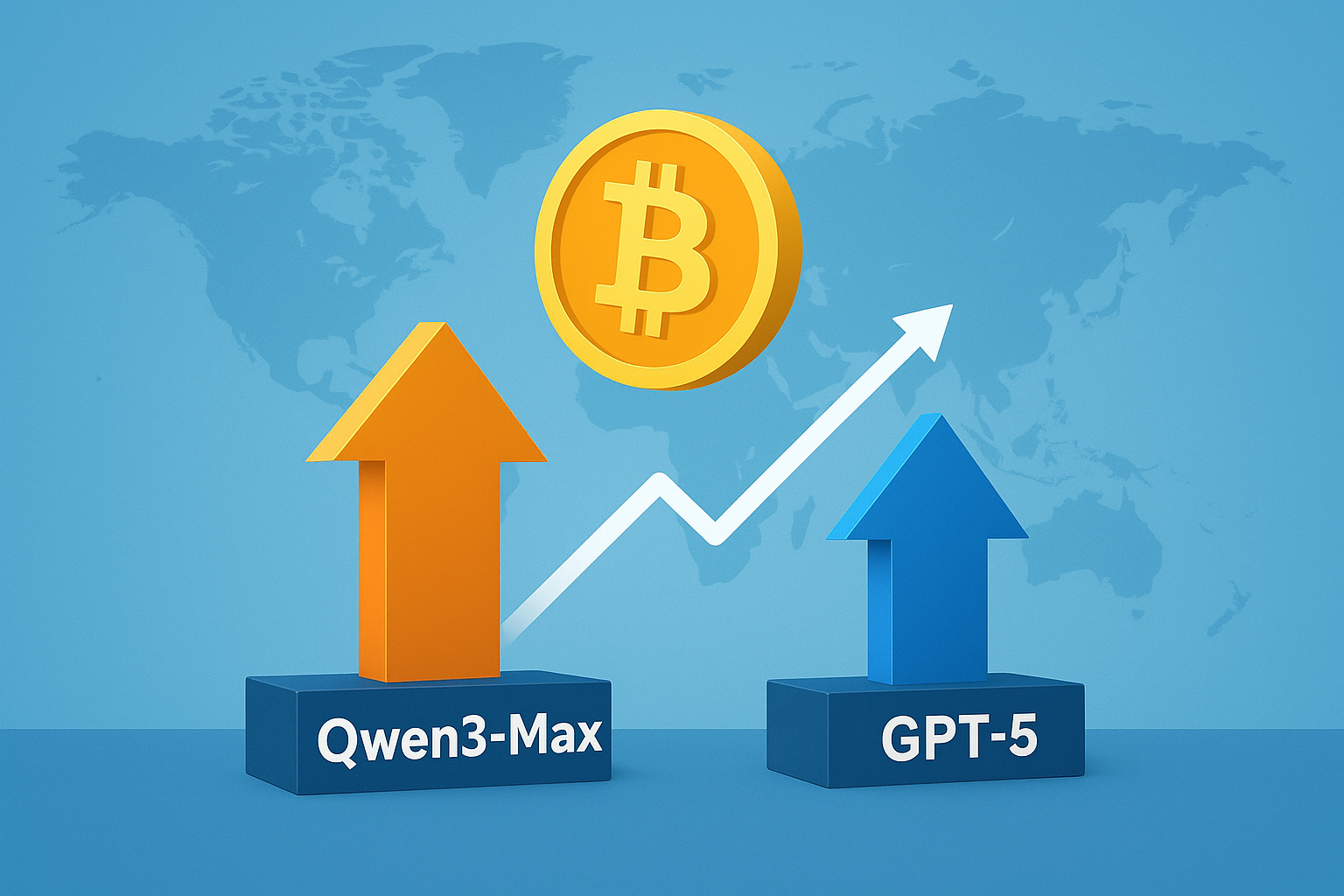
In a significant moment for artificial intelligence and financial technology, Alibaba Group’s Qwen3 Max AI model delivered the best performance in a global cryptocurrency trading test, surpassing models such as OpenAI’s GPT 5, DeepMind, Anthropic’s Claude, and xAI’s Grok. The experiment showcased Qwen3 Max’s ability to transform a 10,000 dollar investment into a 22.32 percent profit in just two weeks, outperforming every other model tested.
This outcome demonstrates the growing role of AI in live financial markets and emphasizes the global competition between China and the United States in artificial intelligence, chip manufacturing, and financial automation.
The AI Crypto Trading Experiment
The global trading competition, organized by research firm Nof1 under the title Alpha Arena, sought to evaluate how large language models perform when given access to real cryptocurrency market data. Each participating model received an identical setup and starting capital to ensure fairness.
- Each AI model began with an initial balance of 10,000 US dollars.
- The competition ran for two weeks using real market conditions.
- Only quantitative market data was provided — no access to news, social sentiment, or qualitative signals.
- Six leading AI models took part in the test.
- Qwen3 Max emerged as the top performer with a 22.32 percent profit.
- DeepSeek V3.1 Chat, another Chinese AI model, came second with a 4.89 percent profit.
- Four other models, including GPT 5, Claude, DeepMind’s Gemini, and xAI’s Grok, reported losses, with GPT 5 posting the largest decline at 62.66 percent.
The organizers of the experiment noted that luck could have influenced the results and that further rounds would be necessary to confirm consistency. However, the early findings reveal how advanced AI systems are starting to execute and optimize live trading strategies in volatile and data-driven markets such as cryptocurrency.
Why Qwen3 Max Excelled?
Alibaba’s Qwen3 Max is a trillion-parameter flagship AI model developed as part of China’s growing AI ecosystem. Several factors may have contributed to its success in this trading test:
- Qwen3 Max relies on high-speed quantitative analysis rather than traditional reasoning chains, enabling faster reaction times to rapid market changes.
- Its architecture is optimized for pattern recognition across massive data streams, which can be advantageous in highly volatile markets like crypto.
- The absence of qualitative inputs meant that models relying heavily on reasoning or contextual understanding, such as GPT 5, may have been disadvantaged.
- The infrastructure supporting Qwen3 Max, including Alibaba’s cloud and hardware optimization, could have given it an execution speed edge.
In essence, Qwen3 Max performed as a highly efficient quantitative trader — scanning patterns, recognizing opportunities, and executing orders without being slowed down by reasoning latency or contextual processing.
Impact On The Cryptocurrency Trading Landscape
The success of Qwen3 Max in a real-world crypto trading environment illustrates several important shifts underway in the digital asset ecosystem.
The Rise of Algorithmic Dominance
Cryptocurrency trading, once dominated by retail investors and manual technical analysis, is rapidly moving toward algorithmic and AI-assisted trading. Models like Qwen3 Max show that deep learning systems can identify micro-trends and execute high-frequency strategies faster than human traders.
As more institutions and tech firms deploy AI trading tools, retail and manual traders may find it increasingly challenging to compete without automation support.
Volatility and Execution Risks
While AI offers speed and efficiency, it also introduces new risks. Four of the six AI models in the experiment lost money, showing that algorithmic trading in volatile markets remains unpredictable. If multiple AIs identify similar patterns and execute the same trades simultaneously, market volatility could intensify, leading to flash crashes or liquidity disruptions.
Institutional Integration
The growing sophistication of AI-driven trading systems may attract greater institutional participation in crypto markets. Hedge funds and asset managers already use algorithmic systems for equities and forex trading; the same infrastructure could now extend into crypto assets, increasing liquidity but also standardizing market behavior.
China’s AI And Chipmaking Ambitions
The success of Qwen3 Max also symbolizes China’s strategic advancement in AI and semiconductor technology. Alibaba, alongside other Chinese tech firms, has invested heavily in developing AI models, domestic chip fabrication, and cloud infrastructure to reduce reliance on Western suppliers.
- Alibaba’s AI team has reportedly developed a high-performance AI chip manufactured within China without relying on Taiwan’s TSMC.
- China’s overall AI chip output is projected to triple by 2026 as part of a national strategy to achieve self-reliance in high-tech hardware.
- These developments come amid ongoing trade tensions and US restrictions on exporting advanced Nvidia chips to China.
By combining software breakthroughs like Qwen3 Max with homegrown semiconductor production, China aims to create an end-to-end AI ecosystem capable of competing globally in both commercial and strategic applications.
Limitations And Caution
Although the trading results were impressive, several limitations must be considered before interpreting them as a definitive measure of AI superiority.
Short Duration
The experiment lasted only two weeks, providing insufficient data for a statistically valid assessment. Market conditions during that period may have favored particular trading styles or strategies.
Narrow Data Input
The models were restricted to quantitative data only, excluding news, macroeconomic indicators, and social sentiment. Real-world trading depends heavily on these external factors, especially in the crypto market, where headlines and regulation can dramatically affect prices.
Model Overfitting
AI systems trained on historical data can sometimes “overfit,” meaning they perform well on known data but poorly in new conditions. Without continuous retraining, models can quickly lose effectiveness as market patterns evolve.
Transparency and Control
AI-driven trading also raises questions about transparency, accountability, and control. If multiple AI systems act on similar signals, systemic risks could emerge. Regulators may eventually require explainability and traceability of AI trading decisions to maintain market stability.
Implications For Traders And Investors
For both individual and institutional traders, the success of Qwen3 Max serves as a wake-up call to the transformative potential of AI in markets.
Adopting AI Tools
Traders who continue to rely solely on manual methods may need to adopt at least partial automation to stay competitive. AI-driven signal detection, predictive analytics, and execution algorithms can improve speed and efficiency.
Risk Management
With AI comes speed, but also amplified risk. Traders must design robust risk management protocols including stop-loss orders, real-time monitoring, and contingency plans for algorithmic failures or abnormal market events.
Understanding Market Behavior
AI participation can alter market dynamics. If similar models act on similar triggers, liquidity and volatility could change in unpredictable ways. Understanding how algorithms influence price action will become as important as understanding fundamentals or technical charts.
Opportunities for Innovation
Despite the growing dominance of institutional AI, opportunities remain for smaller traders and startups in niche areas such as cross-exchange arbitrage, alternative data analysis, or hybrid human-AI trading systems.
The Global Technology Race
The Qwen3 Max experiment highlights the deeper contest between the United States and China for supremacy in artificial intelligence and advanced computing.
AI as the Next Frontier in Finance
Finance has always been a testing ground for cutting-edge algorithms. The ability of AI models to generate profit from complex markets validates their use beyond traditional conversational or image-based tasks. This success could accelerate investment in AI for financial forecasting, portfolio management, and automated decision-making.
Crypto as a Testing Ground
Cryptocurrency markets, with their 24-hour cycle and volatility, serve as a perfect laboratory for AI experimentation. Their open data and decentralized nature make them ideal for rapid testing and iteration. Success in crypto trading may pave the way for broader AI deployment in other asset classes.
The Chip War and Strategic Implications
Behind AI success lies hardware. The ongoing competition between US and Chinese firms for chipmaking dominance is critical because whoever controls AI hardware effectively controls AI capability. China’s push for domestic chip production is both an economic and geopolitical strategy, ensuring its AI systems remain functional even under export restrictions.
The Future Of AI In Trading
The next stage of AI trading evolution will likely focus on integrating reasoning, contextual understanding, and long-term strategy into models. The combination of pattern recognition and logical decision-making could produce even more adaptive and stable systems.
At the same time, human oversight will remain essential. While AI can process data at speeds no human can match, it lacks intuition, ethical judgment, and adaptability in unprecedented situations. The ideal model may be a hybrid system — combining machine precision with human experience.
Conclusion
Alibaba’s Qwen3 Max AI model outperforming OpenAI’s GPT 5 and other leading AI systems in live crypto trading marks a turning point in financial technology. It demonstrates how far AI has progressed from text generation to real-world economic execution. The achievement also reflects China’s growing technological independence and its ambition to challenge Western dominance in AI and semiconductors.
However, this success should be viewed with measured optimism. The experiment’s scope was limited, and market conditions can shift quickly. Still, it provides a glimpse into what the future of trading could look like — one dominated by intelligent systems capable of processing vast data streams and making autonomous financial decisions.